Forex Liquidity Bridge
Multi-LP Aggregation Engine
Connect multiple MetaTrader liquidity providers to your trading platforms — including MetaTrader 4, MetaTrader 5, and custom platforms. Aggregated user liquidity API via FIX protocol, with price aggregation, symbol mapping, markup profiles, and distribution via TCP, WebSocket, or FIX — all from one low-latency engine.
Makers & Takers
Internal Latency
Taker Protocols
Expert Support
How Our Forex Liquidity Bridge Works
LiquidityBridge sits between your Liquidity Providers (Makers) and Trading Platforms — including MT4, MT5, and custom platforms (Takers) — as intelligent middleware. It keeps connections alive, aggregates prices, and distributes market data across protocols.
Primary LP — FIX API
Secondary LP — FIX API
Add unlimited LPs
Liquidity
Bridge
Trading Platform — TCP
Trading Platform — WS
Trading Platform — FIX
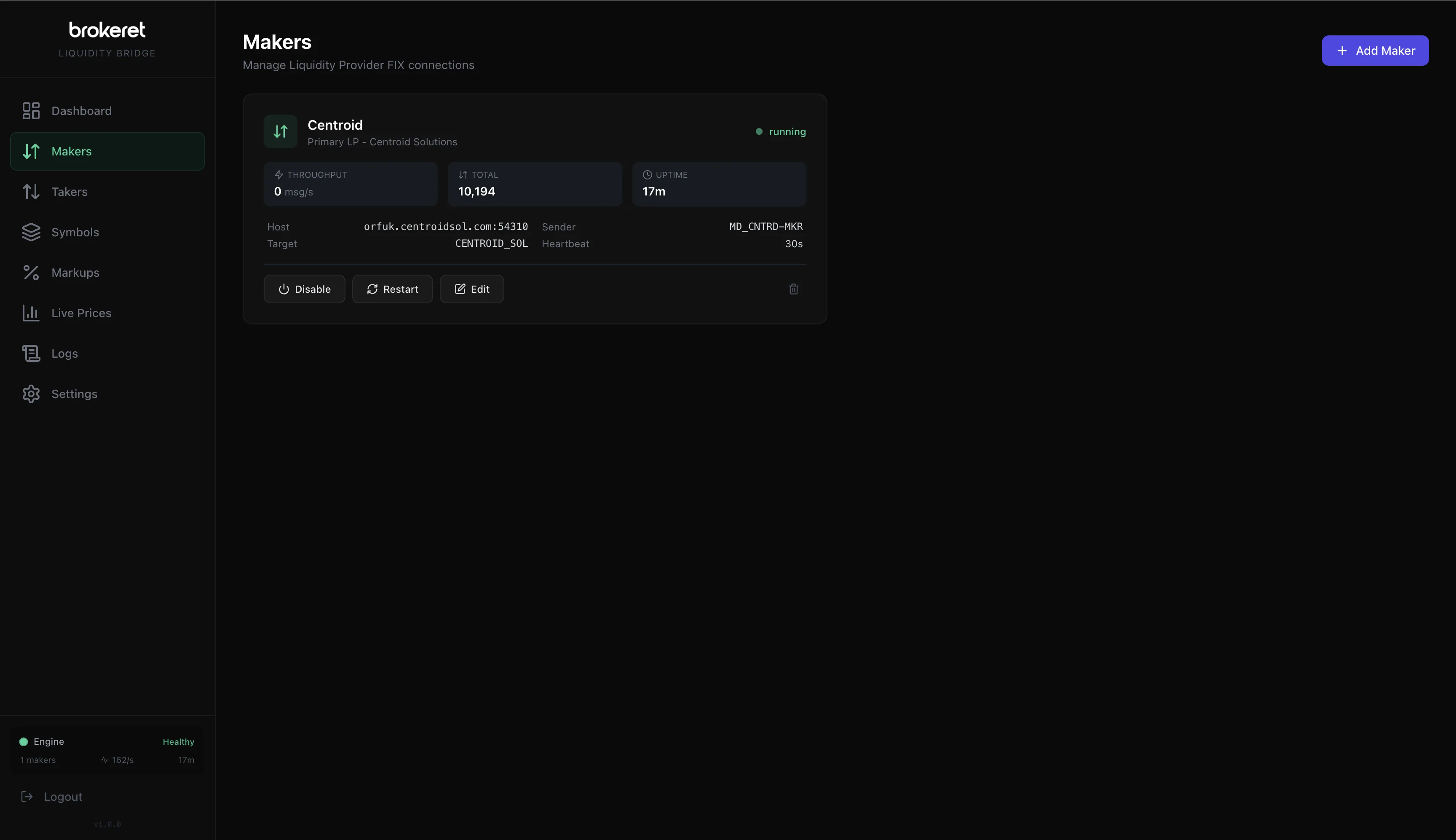
Connect Any LP via FIX API
Add unlimited Liquidity Providers via FIX 4.4 protocol. Each Maker connection is managed independently with its own host, sender/target comp IDs, heartbeat interval, and reconnection logic. Monitor throughput, total messages, and uptime per LP in real-time.
- FIX 4.4 protocol with configurable heartbeat
- Auto-reconnect with persistent session management
- Per-LP throughput, message count, and uptime monitoring
- Restart and edit connections without downtime
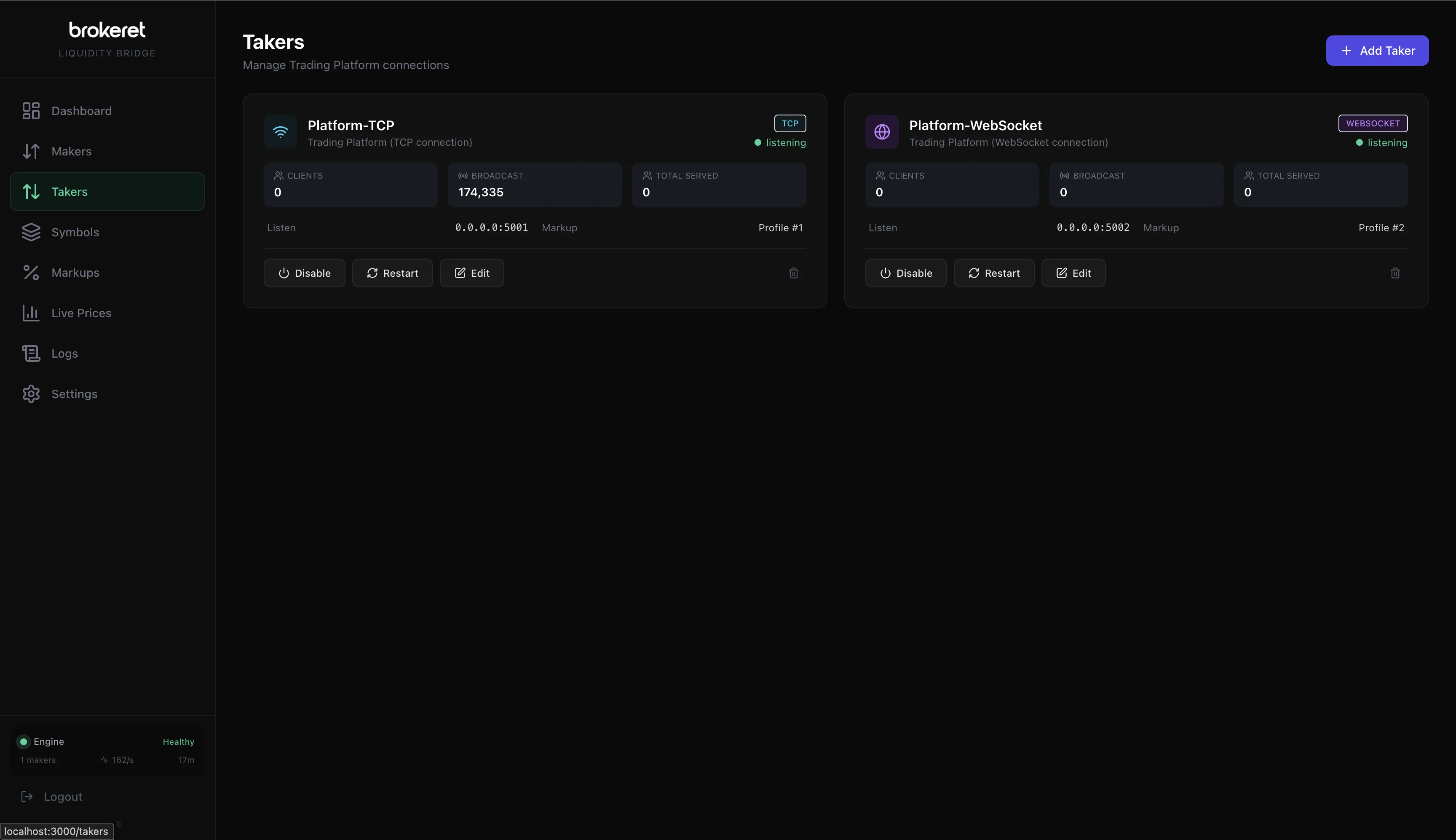
Distribute to MT4, MT5 & Custom Platforms via Any Protocol
Connect MetaTrader 4, MetaTrader 5, and custom trading platforms as Takers — each with its own protocol. One platform uses TCP, another uses WebSocket, a third uses FIX — LiquidityBridge handles the protocol translation and broadcasts aggregated prices to all simultaneously.
- TCP, WebSocket, and FIX taker protocols supported
- Per-platform client count, broadcast stats, and health
- Assign Markup Profiles per Taker for custom pricing
- Independent listen ports and connection management
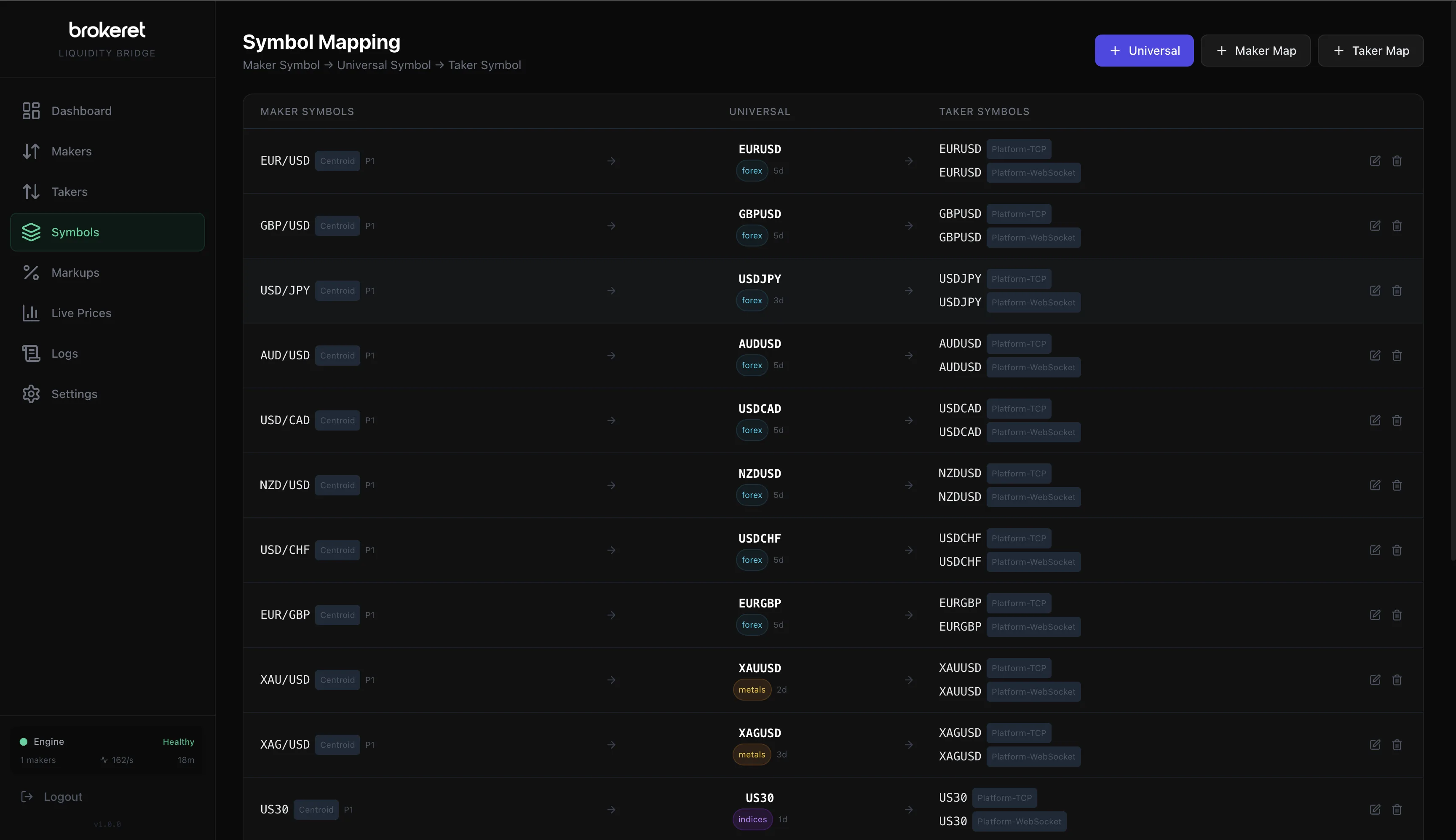
Maker → Universal → Taker
Every LP has its own symbol naming convention. Your platforms have theirs. LiquidityBridge uses a three-layer mapping system — Maker Symbol → Universal Symbol → Taker Symbol — to translate between them automatically.
Maker Symbols
LP sends EUR/USD, XAU/USD, US30 — each LP can use different naming. Map each to a Universal symbol.
Universal Symbols
A normalised symbol with asset class tag (forex, metals, indices, crypto, commodities). This is where aggregation happens.
Taker Symbols
Each platform gets its own mapping. Platform-TCP receives EURUSD, Platform-WebSocket receives EURUSD — same source, different endpoints.
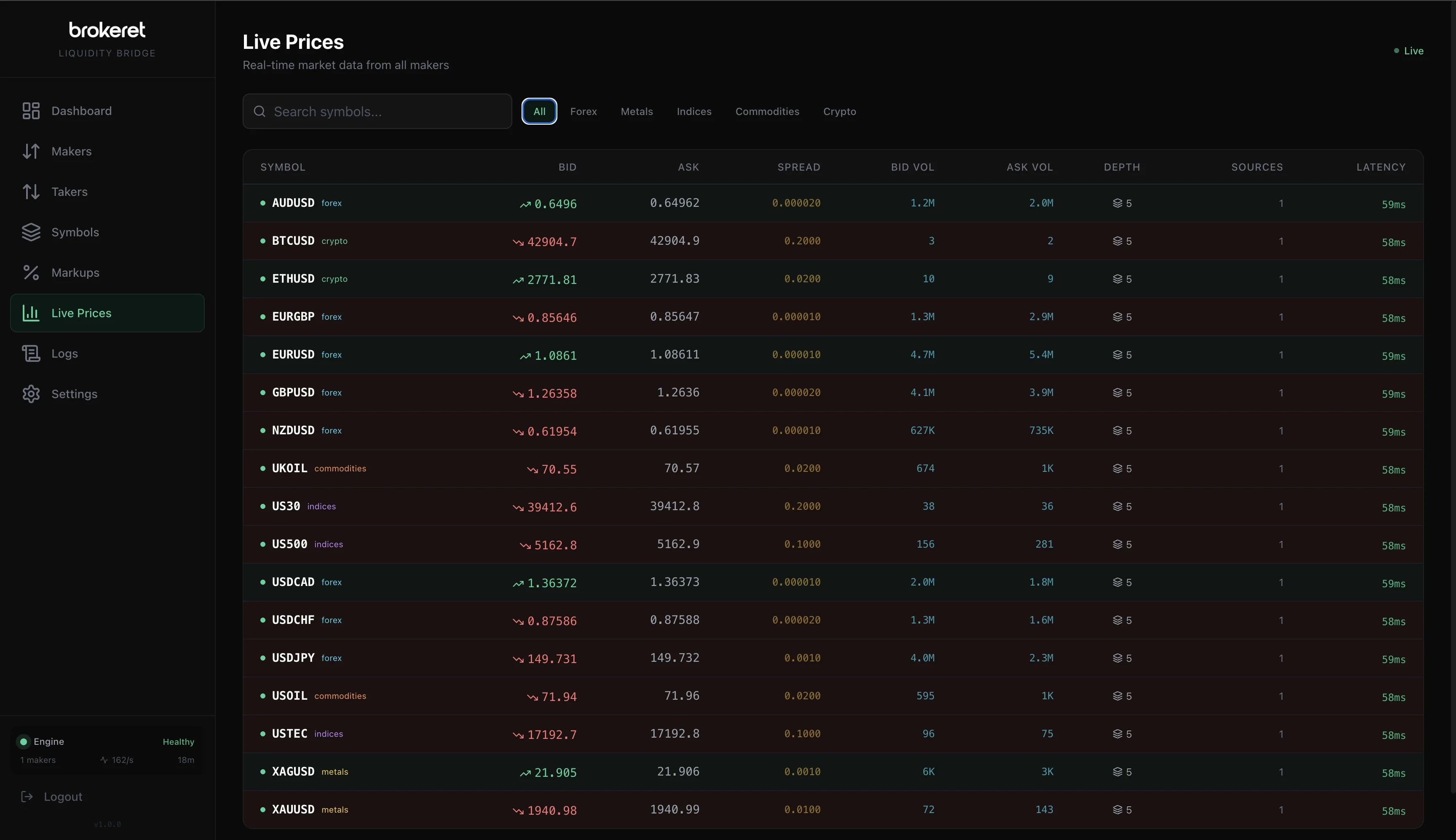
Multi-LP Price Aggregation
When the same symbol is received from multiple Makers, LiquidityBridge aggregates the best bid/ask to create a composite feed. Monitor spreads, bid/ask volumes, market depth, source count, and latency per symbol — filter by asset class and search in real-time.
Best Price Aggregation
Best bid from all Makers, best ask from all Makers
Volume & Market Depth
Bid volume, ask volume, and depth of book per symbol from all sources
Primary / Fallback Priority
XAUUSD → Maker 1 primary, Maker 2 fallback
Asset Class Filtering
All, Forex, Metals, Indices, Commodities, Crypto — with search
Custom Spread Markup per Taker
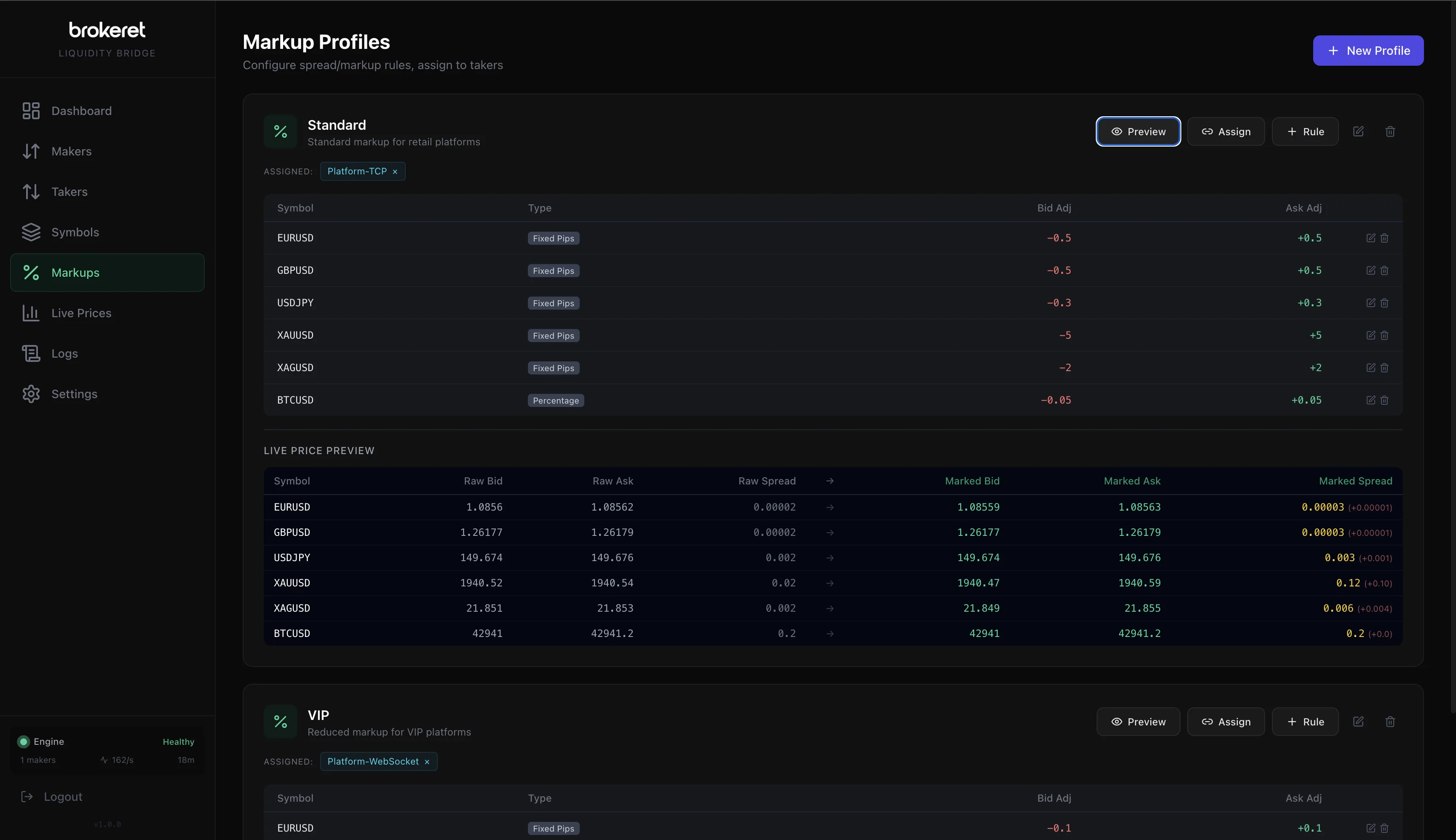
Create named markup profiles — Standard, Premium, VIP — and assign them to specific Takers. Each profile defines per-symbol spread rules (fixed pips or percentage) so different platforms receive different pricing from the same LP feed. Preview raw vs marked prices in real-time before going live.
Fixed Pips & Percentage Markup
Define per-symbol markup rules — fixed pips for EURUSD, percentage for BTCUSD. Bid and ask adjustments shown separately for full transparency.
Live Price Preview
See raw bid/ask vs marked bid/ask side by side in real-time. Compare raw spread against marked spread before applying to production.
Assign to Takers
Link any profile to any Taker. Platform-TCP gets Standard markup, Platform-WebSocket gets VIP pricing — same LP feed, different spreads.
Instant Profile Creation
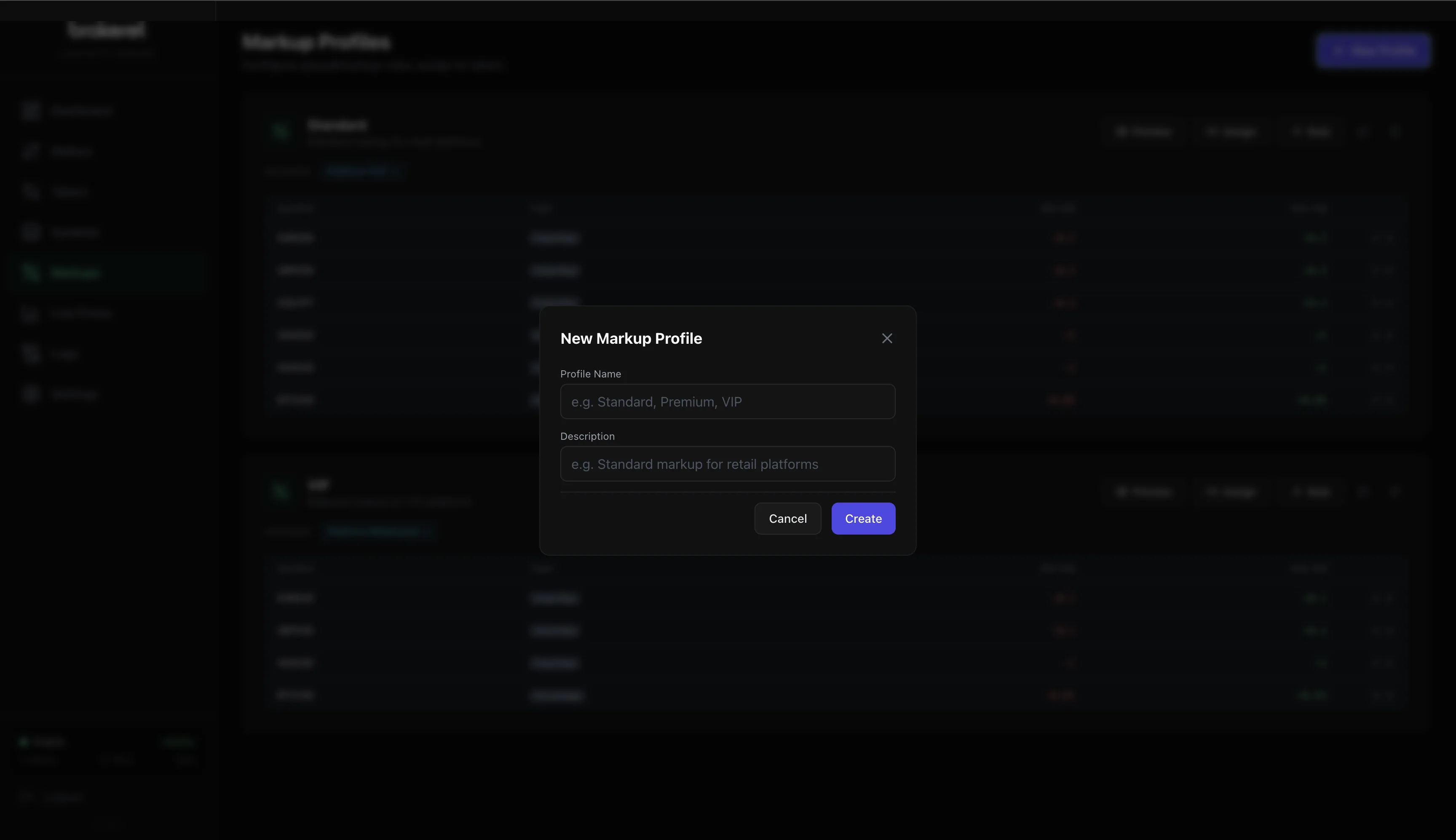
Create new profiles on the fly with a name and description. Apply to Takers immediately — no restart required.
Engine Capabilities
Everything a brokerage needs to manage liquidity, pricing, and platform connectivity from a single bridge engine.
Persistent FIX Sessions
Maintains persistent FIX 4.4 sessions with each LP, including auto-reconnect, heartbeat monitoring, sequence number management, and session recovery so connections stay alive through network blips.
Multi-Protocol Distribution
Distribute aggregated prices to trading platforms via TCP, WebSocket, or FIX. Each Taker can use a different protocol, and the bridge handles protocol translation transparently on its own.
Ring Buffer Pipeline
High-throughput ring buffer architecture ensures zero message loss under load. Monitor buffer utilisation, processed messages, aggregated ticks, and error rates from the dashboard in real-time.
Latency Monitoring
Track end-to-end latency per symbol, from LP tick arrival to platform broadcast. Sub-millisecond internal processing with per-symbol age tracking ensures you know exactly how fresh your prices are.
Spread Monitoring
Real-time spread display per symbol with colour-coded indicators. Instantly identify widening spreads, stale prices, or LP feed issues before they impact your clients.
Hot Configuration
Add Makers, Takers, symbol maps, and markup profiles without restarting the engine. Restart individual connections independently, so production traffic is never interrupted during changes.
Intelligent Alerts
Proactive monitoring with configurable alert rules covering Maker disconnect, Taker disconnect, high latency, and buffer overflow. Set thresholds, check intervals, cooldown periods, and track alert history.
Automated S3/R2 Backups
Automatically backup bridge configuration to AWS S3 or Cloudflare R2 at configurable intervals. Test connections on demand, trigger manual backups, and track backup history with error monitoring.
Email Notifications (SMTP)
SMTP email integration for alert delivery and admin password resets. Full TLS/SSL support with built-in connection testing means you never miss a critical bridge event again.
Full Transparency, Real-Time Logs
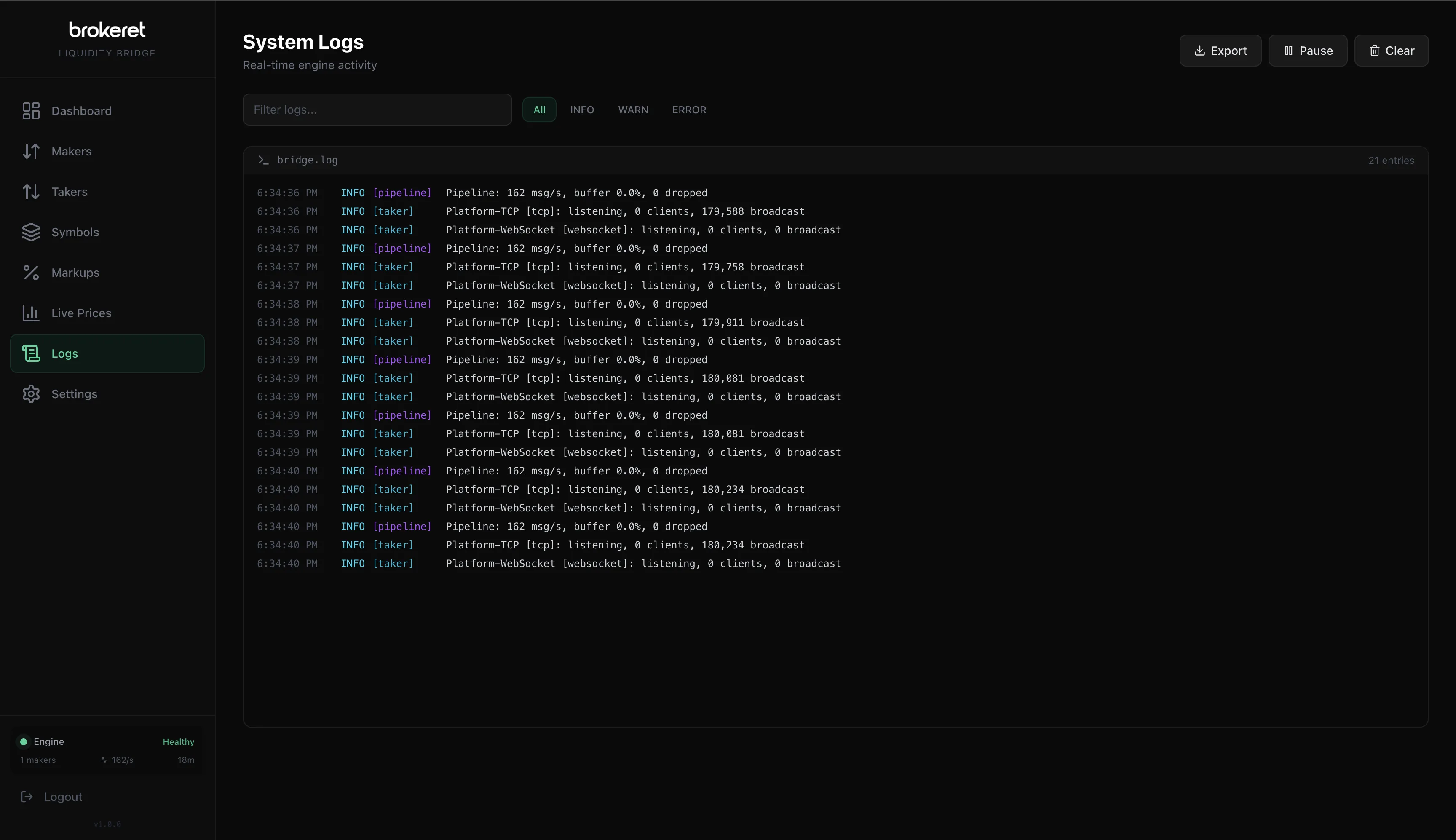
Every action the bridge takes is logged — FIX sessions, taker broadcasts, pipeline processing, errors, and warnings. Filter by level (INFO, WARN, ERROR), search by keyword, and monitor engine activity in real-time.
Full Control Over Your Bridge Instance
Configure engine tuning, set up intelligent alerts, automate backups to S3/R2, and enable email notifications — all from a centralised settings panel.
General Settings
Engine tuning, security & display
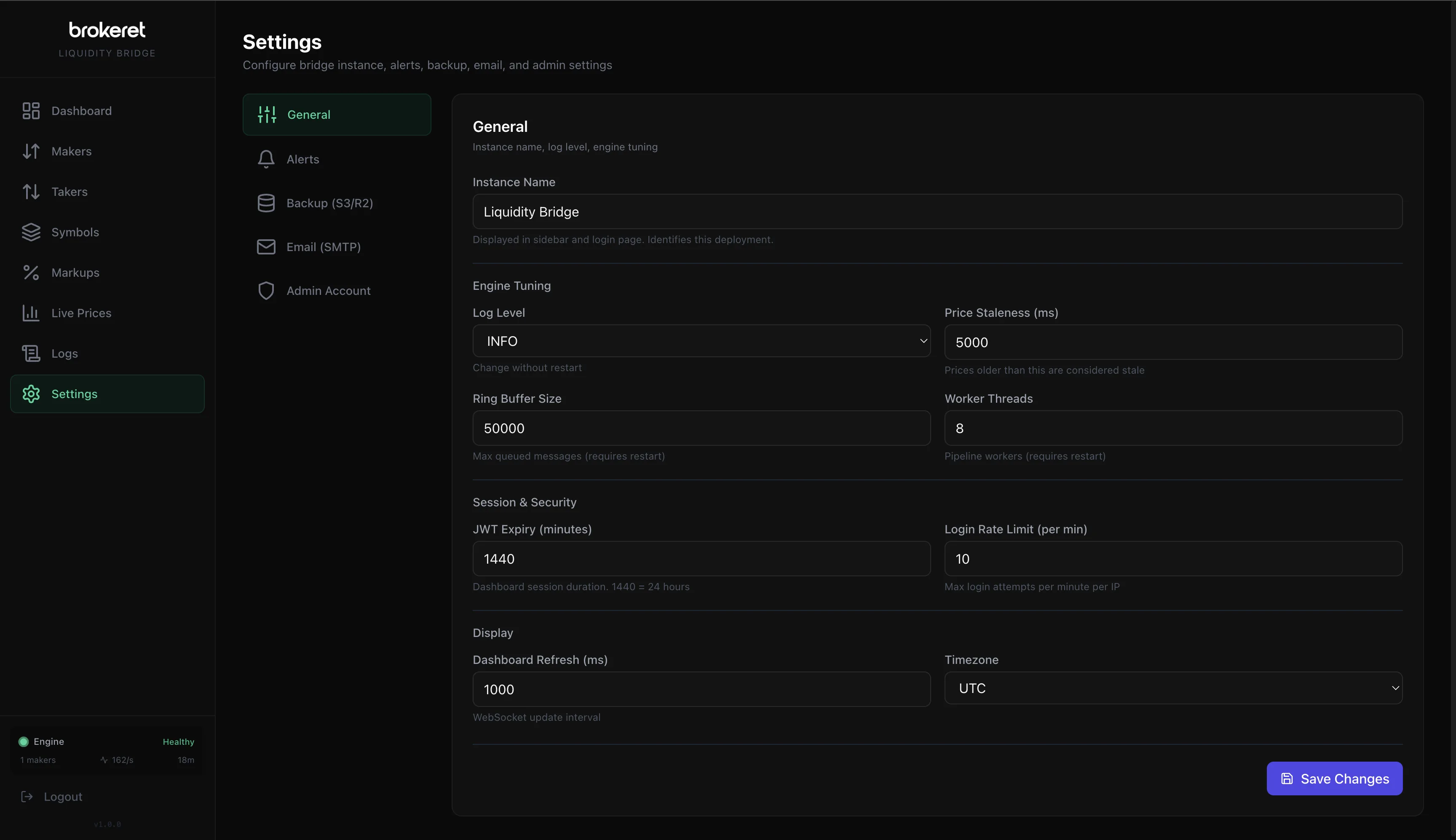
Configure instance name, log level, price staleness thresholds, ring buffer size, worker threads, JWT session expiry, login rate limiting, dashboard refresh interval, and timezone — all without restarting the engine.
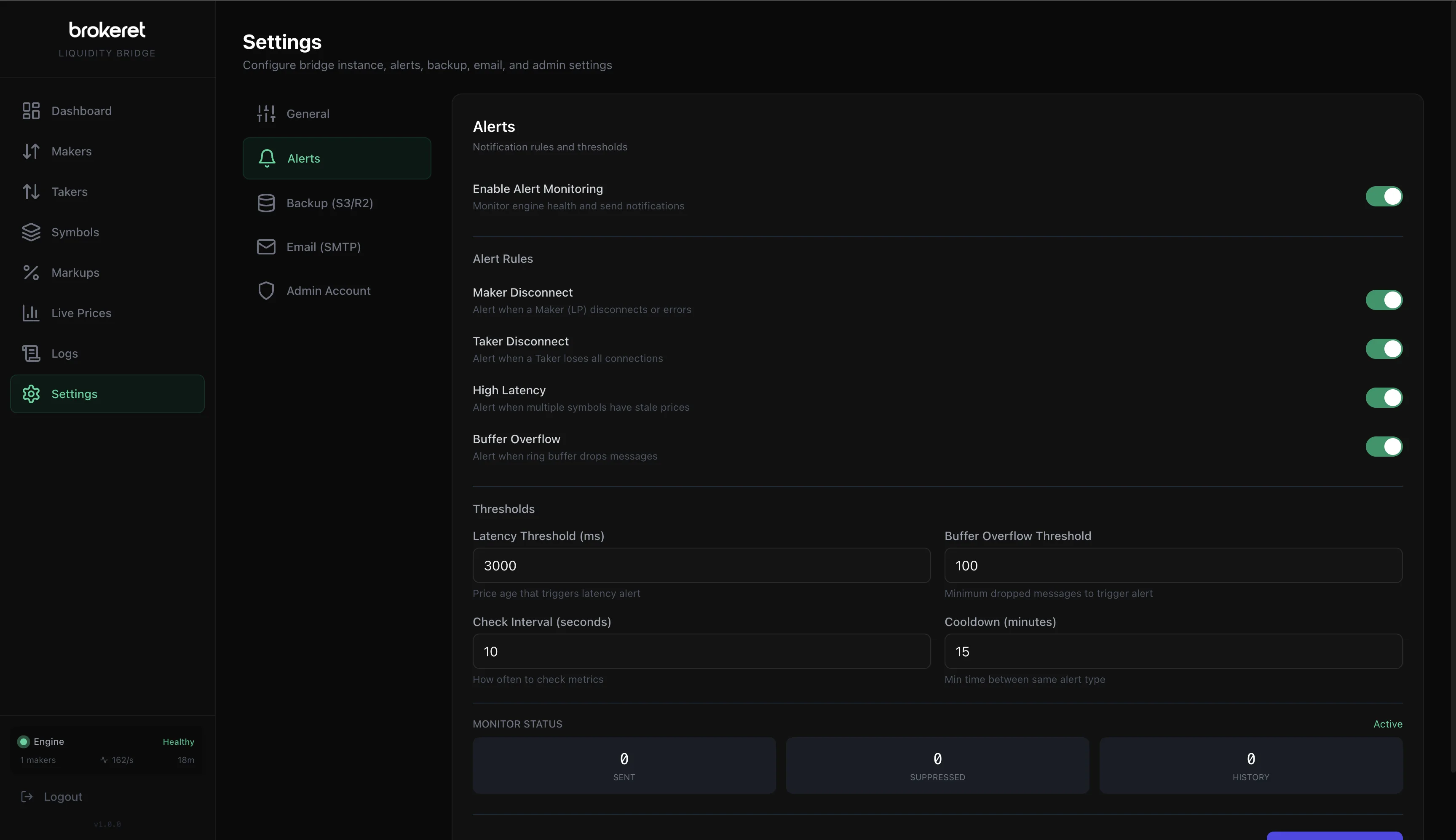
Smart Alerts
Proactive health monitoring
Enable intelligent alert rules — Maker disconnect, Taker disconnect, high latency, and buffer overflow. Set latency thresholds, check intervals, and cooldown periods. Monitor sent, suppressed, and historical alert counts in real-time.
Automated Backups
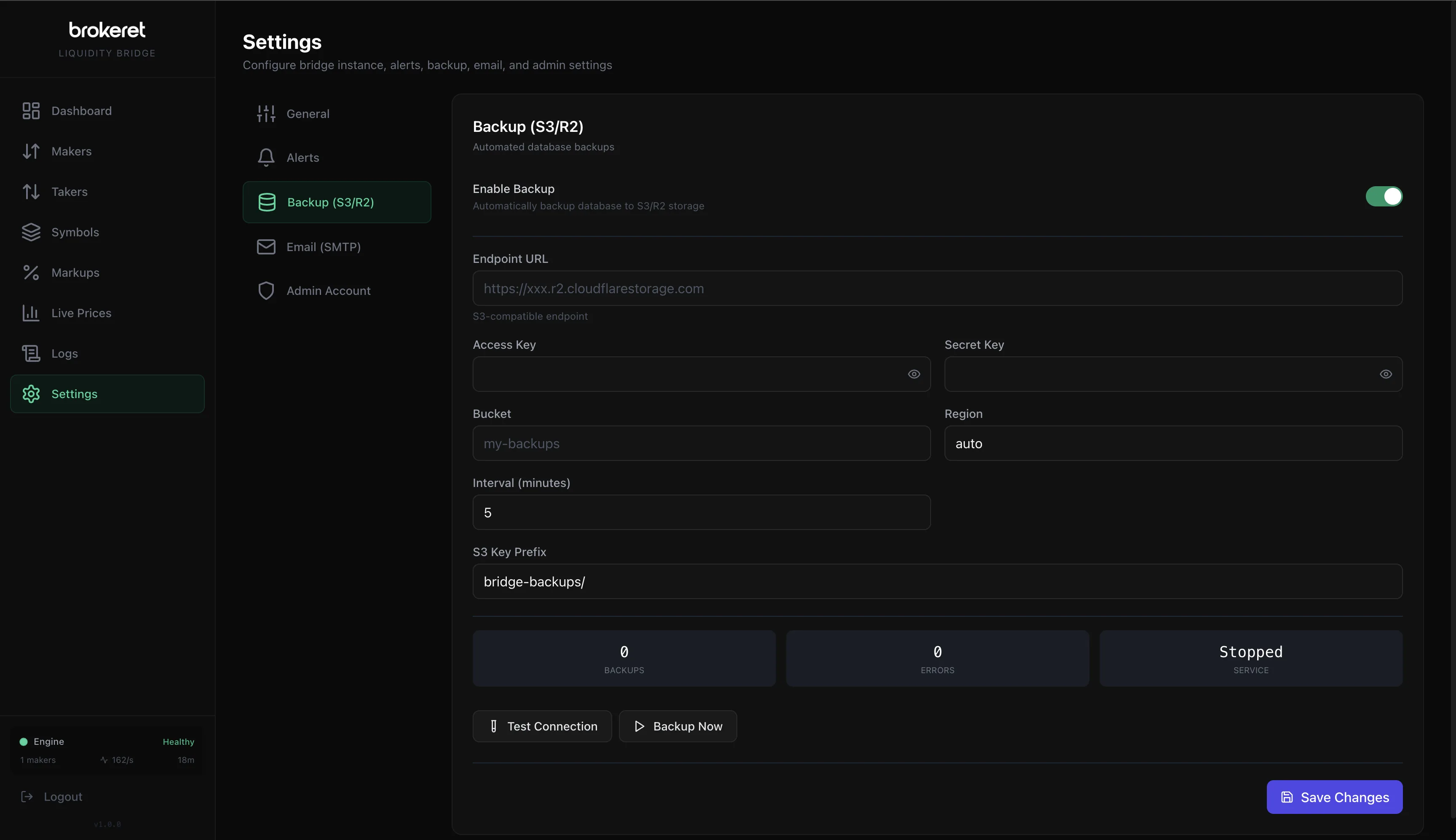
S3 & Cloudflare R2 compatible
Automatically backup your bridge configuration to any S3-compatible storage — AWS S3 or Cloudflare R2. Configure endpoint URL, access credentials, bucket, region, backup interval, and key prefix. Test connections and trigger manual backups on demand.
Email Notifications
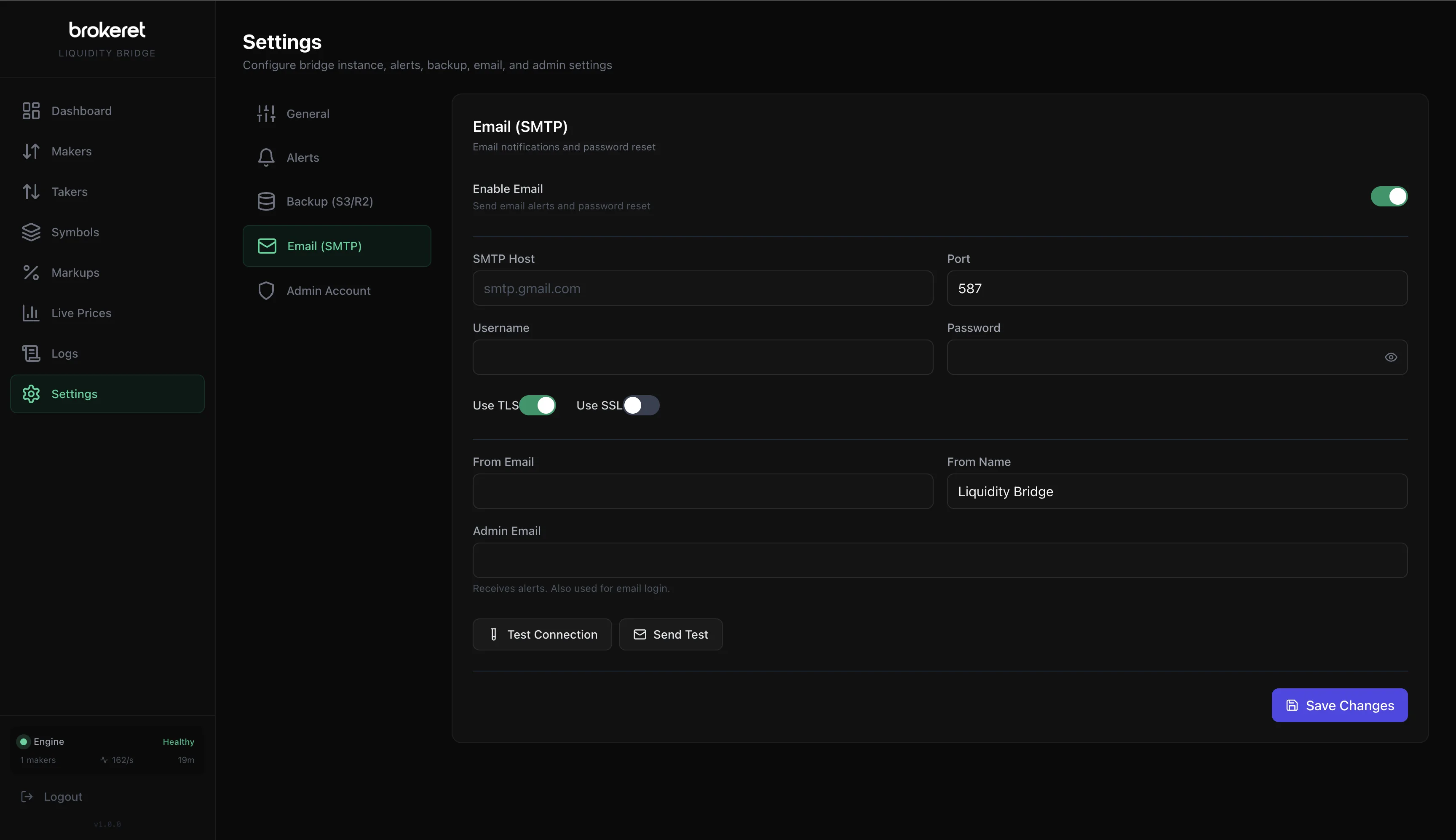
SMTP with TLS/SSL support
Configure SMTP for alert email delivery and admin password resets. Full TLS/SSL support, configurable from/admin email addresses, and built-in connection testing with one-click test email sending — never miss a critical bridge event.
See It in Action
Watch LiquidityBridge handle live market data — from FIX connection to platform broadcast — in real-time.
Why LiquidityBridge
Purpose-built for brokerages that need control over their liquidity stack — compared to traditional forex bridge providers, LiquidityBridge offers multi-protocol flexibility, per-taker markups, and hot configuration at a fraction of the cost.
| Capability | LiquidityBridge | Traditional Bridge Providers |
|---|---|---|
| Multi-LP FIX Connectivity | ||
| Multi-Protocol Takers (TCP/WS/FIX) | Usually FIX only | |
| Price Aggregation | ||
| 3-Layer Symbol Mapping | Basic mapping | |
| Per-Taker Markup Profiles | Global only | |
| Hot Configuration (No Restart) | ||
| Real-Time Web Dashboard | CLI / limited | |
| Setup Complexity | Simple | Weeks / months |
| Intelligent Alerts & Monitoring | Basic / email only | |
| Automated S3/R2 Backups | ||
| Cost | Affordable | $2K–$10K/mo |
Go Live with LiquidityBridge in 4 Steps
From LP credentials to live price distribution
Connect LPs
Provide your FIX API credentials — we establish persistent sessions with your Liquidity Providers.
Map Symbols
Map LP symbols → Universal → platform naming. Configure aggregation and priority rules.
Connect Platforms
Configure TCP, WebSocket, or FIX endpoints and assign markup profiles per platform.
Go Live
Prices flowing, spreads monitored, logs streaming — with 24/7 expert support.
Frequently Asked Questions
What is LiquidityBridge?
LiquidityBridge is middleware that sits between your Liquidity Providers (Makers) and Trading Platforms (Takers). It maintains persistent FIX API connections to LPs, aggregates prices from multiple sources, maps symbols between different naming conventions, applies spread markups, and distributes market data to your platforms via TCP, WebSocket, or FIX protocols.
What protocols are supported on the Maker side?
Makers connect via FIX 4.4 protocol. Each connection is configured with host, port, sender/target comp IDs, and heartbeat interval. The bridge handles session management, sequence numbering, and auto-reconnection automatically.
What protocols are supported on the Taker side?
Takers can connect via TCP, WebSocket, or FIX. You can run multiple Takers simultaneously with different protocols — for example, one platform on TCP and another on WebSocket. Each Taker gets its own listen port and connection management.
How does price aggregation work?
When the same symbol (e.g., XAUUSD) is received from multiple Makers, LiquidityBridge can aggregate the best bid/ask to create a composite feed. If aggregation is not enabled or only one Maker provides the symbol, you can map it with primary/fallback priority — XAUUSD from Maker 1, failover to Maker 2.
What is the 3-layer symbol mapping?
LiquidityBridge uses Maker Symbol → Universal Symbol → Taker Symbol mapping. Your LP sends "EUR/USD", the bridge normalises it to Universal "EURUSD" (tagged as forex), and then maps it to each Taker's naming convention. This allows different LPs and platforms with different symbol names to work together seamlessly.
Can I add spread markup per platform?
Yes. Create Markup Profiles (e.g., Standard, Premium, VIP) with per-symbol spread rules, and assign them to specific Takers. Different platforms can receive different pricing from the same LP feed.
How many Makers and Takers can I connect?
There is no artificial limit. Add as many Liquidity Providers and Trading Platforms as your infrastructure requires. Each connection is managed independently with its own monitoring and health tracking.
Can I add or remove connections without restarting?
Yes. LiquidityBridge supports hot configuration — add new Makers, Takers, symbol maps, and markup profiles without restarting the engine. You can also restart individual connections independently without affecting others.
What monitoring is available?
The real-time dashboard shows Maker/Taker status, live prices with bid/ask/spread/volume/depth, throughput (messages per second), ring buffer utilisation, processed/aggregated message counts, error rates, and per-symbol latency. Full system logs with level filtering, export, and search are also available.
Does LiquidityBridge support alerts and notifications?
Yes. Configure intelligent alert rules for Maker disconnect, Taker disconnect, high latency, and buffer overflow. Set latency thresholds, check intervals, and cooldown periods. Alerts are delivered via email (SMTP) with full monitoring of sent, suppressed, and historical alerts.
Can I backup the bridge configuration?
Yes. LiquidityBridge supports automated backups to any S3-compatible storage — AWS S3 or Cloudflare R2. Configure endpoint URL, access credentials, bucket, region, interval, and key prefix. You can also test connections and trigger manual backups from the settings panel.
What is a liquidity bridge?
A liquidity bridge is middleware that connects trading platforms to liquidity providers, enabling price streaming, order routing, and trade execution. In the forex and CFD industry, bridges are essential infrastructure that translate between different protocols (FIX, TCP, WebSocket) so brokers can aggregate prices from multiple LPs and distribute them to platforms like MetaTrader 4 and MetaTrader 5.
Does LiquidityBridge work with MetaTrader 4 and MetaTrader 5?
Yes. LiquidityBridge connects to MT4 and MT5 platforms via TCP and FIX protocols on the Taker side. Your MetaTrader server connects as a Taker, receiving aggregated and marked-up prices from all configured Liquidity Providers. The bridge handles protocol translation, symbol mapping, and spread markup so your MetaTrader platform receives clean, ready-to-use market data.
Is LiquidityBridge suitable for ECN and STP brokers?
Absolutely. LiquidityBridge supports ECN and STP execution models by aggregating prices from multiple liquidity providers and distributing the best bid/ask to your trading platforms. For ECN brokers, the multi-LP aggregation creates a genuine composite feed. For STP brokers, the bridge passes through LP prices with optional markup — ensuring straight-through processing from LP to client.
How does LiquidityBridge compare to traditional bridge providers?
Traditional bridge providers often charge $2K–$10K per month, require weeks of setup, and lock you into FIX-only taker connectivity. LiquidityBridge offers multi-protocol taker support (TCP, WebSocket, FIX), per-taker markup profiles, hot configuration without restarts, a real-time web dashboard, automated S3/R2 backups, and intelligent alerting — at a fraction of the cost and with significantly faster deployment.
Still have questions?
Our team is here to help. Get in touch and we’ll walk you through it.
The infrastructure behind financial institutions
Powering forex brokers, prop firms, bullion platforms, fintechs and wallets with institutional-grade technology.